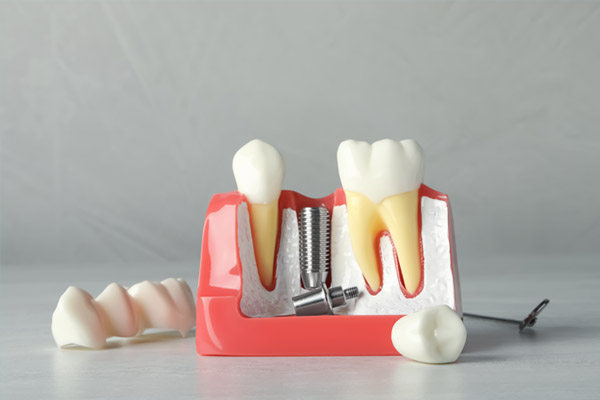
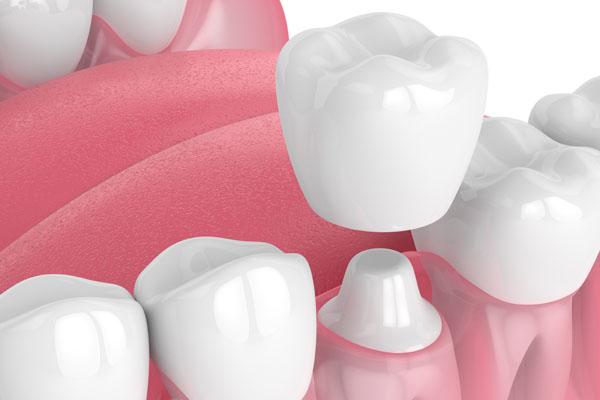
 Crowns are commonly used in dental restorations. A crown is a cap shaped like a tooth but hollow in the middle. It fits over a natural tooth that has to be prepared first. Depending on the issue it is correcting, a crown can be used by itself or as a component of another restoration technique.
Crowns for weakened or damaged teeth
Teeth can be weakened by extensive decay. They can fracture or crack due to trauma. Sometimes a tooth that already has a large filling decays further, and another filling would remove too much of the tooth's surface. Sometimes the only way to save a tooth is by performing a root canal, which can weaken the tooth by removing the diseased pulp. In all of these cases, a crown can strengthen and protect the damaged or weakened tooth, restoring its function and appearance and preventing further damage.
A crown belongs to a class of dental restorations called indirect restorations. This means that they are crafted outside the mouth. Before a dentist can place a crown, the tooth has to be prepared. This involves removing some of the tooth material so there is room for the crown among the other teeth.
Once the preparation is complete, the dentist takes an impression of the affected tooth, as well as the one opposing it. Using the impression as a template, the crown is crafted to fit precisely over the prepared tooth. When it comes back from the lab, it is cemented in place.
Like most dental restorations, a crown is permanent. Because of the alteration of the tooth, a crown that becomes damaged has to be replaced.
Crowns as part of other dental restorations
By themselves, crowns are used to fortify teeth that remain in the mouth but are no longer strong enough for chewing. Crowns are also used as a component of dental restorations used to replace teeth that are missing.
Bridges
A bridge is a treatment used to fill a gap left by either one missing tooth or up to four adjacent missing teeth. It consists of a dental prosthesis called a pontic molded into the shape of one or more teeth. In a traditional dental bridge, the pontic is anchored in place by two crowns that go over the teeth on either side of the gap. These teeth have to be healthy and strong to support the pontic. They have to be prepared to receive the crowns the same way that a weak or unhealthy tooth would so that there is room enough to accommodate them.
Implants
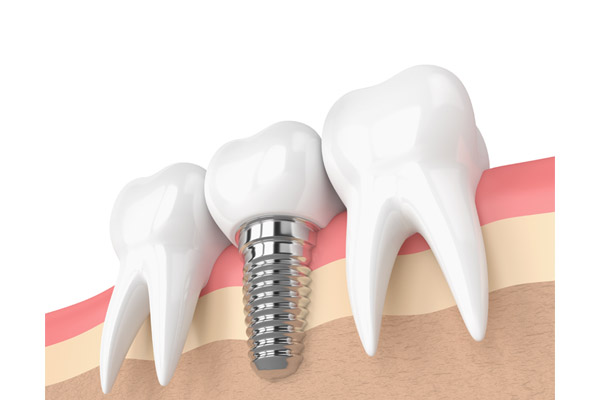
Dental implants are a newer technique used to replace missing teeth. The main component of a dental implant is a metal rod that is implanted into the jawbone. By itself, the rod could not replace the missing tooth. It needs a specially made crown to attach to the rod. The crown resembles the other teeth and performs the same function as a natural tooth.
Conclusion
A crown can be used as a dental restoration by itself to strengthen and support a damaged tooth. By itself, a crown does not replace teeth, but it can help to do so as a component of other dental restorations.
Request an appointment or call Martin Dentistry at 209-299-7907 for an appointment in our Stockton office.
Related Posts
For patients who have damaged or decaying teeth, dental restorations may be a necessity. Dentists use a variety of restorative procedures to protect and repair the structural integrity of an individual's teeth. Some of the most common restoration procedures may include dentures, crowns, and fillings.No individual should suffer from severe tooth pain or discomfort. Decaying…
After getting dental restorations such as fillings, implants, crowns, or root canals, it is important to follow any aftercare instructions given by the dentist. Doing so can help avoid damaging the restoration and causing further harm to the mouth. It can also allow the mouth to heal quickly and properly. Here are some tips commonly…
Healthy teeth are important for many reasons. Strong teeth make it easier to chew food, enunciate speech properly, and even breathe better. Many people also feel more confident when they have strong, healthy teeth that help to create a beautiful smile. Unfortunately, some people are predisposed to decay, fractures, or broken teeth and will need…